Skip to content
Looking to buy a laser welding machine but don’t know where to start? This comprehensive guide covers everything from power requirements to budget considerations, helping you make the right decision for your shop.
Investing in a laser welding machine is a significant decision. With so many options available, it’s easy to feel overwhelmed. But choosing the wrong machine can cost you thousands in wasted investment.
In this guide, we’ll walk you through every factor to consider, ensuring you find the perfect machine for your specific needs.
Understanding Your Power Requirements
The first and most critical factor in choosing a laser welding machine is power output. Your power needs depend directly on the materials you work with.
| Power | Max Thickness (Stainless Steel) | Max Thickness (Carbon Steel) | Best Application |
|---|---|---|---|
| 1000W | 3mm | 3mm | Hobbyists, light repairs |
| 1500W | 4mm | 4mm | Small workshops, thin fabrication |
| 2000W | 5mm | 6mm | Medium fabrication shops |
| 3000W | 8mm | 8mm | Industrial production |
| 6000W+ | 12mm+ | 12mm+ | Heavy industrial use |
Pro tip: Always choose a machine with 20-30% more power than you think you need. This provides a safety margin and extends the machine’s versatility.
Types of Laser Welding Machines
Fiber Laser Welding Machines
Fiber laser welding machines are the most popular choice for modern fabrication shops. Here’s why:
- High efficiency – Up to 30% electrical efficiency
- Low maintenance – No mirrors to align, no gas consumption
- Compact size – Smaller footprint than traditional lasers
- Long lifespan – 20,000+ hours of operation
- Cost-effective – Lower operating costs over time
YAG Laser Welding Machines
YAG (Yttrium Aluminum Garnet) lasers are older technology but still used in specific applications:
- Better for certain specialized metals
- Higher peak power capabilities
- Requires more maintenance
- Higher operating costs
- Less energy efficient
Diode Laser Welding Machines
Diode lasers are the newest technology in laser welding:
- Most compact design
- Lower initial cost
- Still maturing technology
- Limited power options available
- Best for specialized applications
Handheld vs Stationary: Which is Right for You?
Handheld Laser Welding Machines
| Advantage | Disadvantage |
|---|---|
| Portable and flexible | Less precision than stationary |
| Lower cost entry point | Fatigue during extended use |
| Great for on-site repairs | Limited to manual operation |
| Easy to learn | Smaller weld pools |
| Versatile for various jobs | Not ideal for high-volume production |
Stationary/Automated Laser Welding Systems
| Advantage | Disadvantage |
|---|---|
| Superior precision and repeatability | Higher initial investment |
| Higher production speed | Requires more floor space |
| Consistent quality | Longer setup time |
| Can run unattended | Requires trained operators |
| Ideal for high-volume | Less flexible for variety |
Recommendation: For most small to medium fabrication shops, handheld units offer the best value. Upgrade to stationary systems only when you have consistent high-volume production needs.
Key Features to Look For
Essential Features
- Pulse/Continuous Mode – Switch between precision and production welding
- Adjustable Spot Size – Control heat input for different materials
- Wire Feed Capability – For filling gaps and thicker joints
- Water Cooling System – Essential for extended operation
- Digital Control Panel – Precise parameter adjustment
- Built-in Safety Features – Interlocks, emergency stops
Advanced Features (Worth the Investment)
- Wobble Function – Wider weld pools for faster coverage
- Program Memory – Save settings for repeat jobs
- Remote Diagnostics – Technical support via internet
- Auto-Feeding Wire – Consistent filler metal delivery
- Touch Screen Interface – Easier operation
- Laser Power Stabilization – Consistent weld quality
Materials You Can Weld
Not all laser welding machines can handle every material. Here’s a comprehensive breakdown:
| Material | Difficulty | Notes |
|---|---|---|
| Stainless Steel | Easy | Best for beginners, clean welds |
| Carbon Steel | Easy | Similar to stainless steel |
| Aluminum | Moderate | Requires practice, reflectivity issues |
| Copper | Hard | High reflectivity, needs specialized machine |
| Brass | Moderate | Similar challenges to copper |
| Titanium | Hard | Requires inert gas, industrial machines |
Budget Considerations
Price Ranges by Application
| Budget | Power | Best For |
|---|---|---|
| $3,000-$5,000 | 1000W | Hobbyists, home workshops, light repairs |
| $5,000-$8,000 | 1000W-1500W | Small businesses, mobile welders |
| $8,000-$15,000 | 1500W-2000W | Professional fab shops, production work |
| $15,000-$30,000 | 2000W-3000W | Medium industrial, automated options |
| $30,000+ | 3000W+ | Heavy industrial, high-volume production |
Total Cost of Ownership
Beyond the purchase price, consider these ongoing costs:
- Electricity – Laser welding is energy-efficient but runs 2-4 hours daily
- Cooling water – Minimal cost, just distilled water
- Consumables – No electrodes or wire for laser (unlike MIG/TIG)
- Maintenance – Annual servicing, typically $200-$500
- Training – Factor in learning time
ROI Calculation: A $10,000 laser welder can produce $50,000+ in annual revenue for an active fabrication shop.
Brand Comparison
| Brand | Price Range | Strengths | Best For |
|---|---|---|---|
| IPG Photonics | $$$$$ | Industrial-grade, reliability | Heavy production |
| Raycus | $$ | Best value, good support | Small-medium shops |
| JPT | $$ | User-friendly, features | Beginners |
| Maxphotonics | $$$ | Wide power range | Growing businesses |
| nLIGHT | $$$$ | High performance | Precision work |
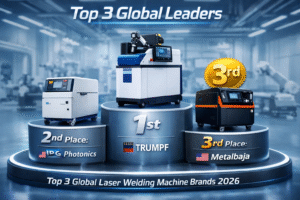
| Metalbaja (Us) | $$$ | US support, warranty, parts | American buyers |
Installation and Space Requirements
Space Requirements
| Machine Type | Footprint | Ceiling Height |
|---|---|---|
| Compact Handheld | 2′ x 2′ | Standard |
| Standard Handheld | 3′ x 3′ | Standard |
| Stationary System | 6′ x 10’+ | 10’+ |
Electrical Requirements
- 1000W machines – Standard 120V outlet
- 1500W-2000W – 240V single phase
- 3000W+ machines – 480V three-phase
Important: Always consult an electrician before installing a high-power laser welding system.
Safety Guidelines
Essential Safety Equipment
- Laser safety glasses – Must match laser wavelength (typically 1064nm)
- Heat-resistant gloves – For handling hot materials
- Protective clothing – Flame-resistant jacket
- Steel-toe boots – For heavy equipment
- Face shield – For additional protection
Workspace Safety
- Adequate ventilation – Laser welding produces fumes
- Fire extinguisher – Always within reach
- Clear workspace – Remove flammables
- Proper grounding – Electrical safety
- Emergency stop – Easy access to shut down
Maintenance and Care
Daily Maintenance (5 minutes)
- Check cooling water level
- Inspect lens for dirt/sputter
- Verify all cables connected
- Test emergency stop
- Clean work surface
Weekly Maintenance (30 minutes)
- Deep clean lens assembly
- Check gas lines (if applicable)
- Inspect wire feed system
- Verify focusing optics
- Check for loose connections
Annual Service (2-4 hours)
- Professional calibration
- Laser source inspection
- Complete electrical check
- Software updates
- Replace worn parts
Expected lifespan: With proper maintenance, a quality fiber laser source lasts 20,000-30,000 hours.
Questions to Ask Before Buying
- What is the warranty period?
- Is technical support available in the US?
- What training is included?
- How long are spare parts guaranteed?
- Can the machine be upgraded later?
- What is the lead time for delivery?
- Do you offer financing options?
- What is the typical maintenance schedule?
How to Test Before You Buy
Whenever possible, always test the machine before purchasing:
- Bring your materials – Test with actual metals you’ll use
- Try different thicknesses – Push the machine to its limits
- Practice basic welds – Assess learning curve
- Check noise levels – Some machines are louder
- Evaluate the interface – Is it intuitive?
- Ask for references – Talk to existing customers
Frequently Asked Questions
How do I know what power I need?
Start by identifying the thickest material you regularly weld. Then choose a machine with enough power to handle that thickness with a margin. A 1500W-2000W machine covers most small to medium shop needs.
What’s the difference between handheld and stationary?
Handheld units offer flexibility and portability, perfect for repairs and varied work. Stationary systems provide precision and speed for high-volume production. Most shops start with handheld.
How long does it take to learn?
Most operators can produce acceptable welds within 1-2 weeks. Becoming proficient takes 1-3 months of regular practice. This is faster than TIG welding, which can take 6+ months.
Can I weld aluminum?
Yes, but it requires more skill than steel. Aluminum reflects laser energy and has different thermal properties. Start with stainless steel before attempting aluminum.
What about warranty and support?
Look for machines with at least 1-year warranty, ideally 2 years. US-based support is crucial for quick issue resolution. At Metalbaja, we offer 2-year warranty with US-based technical support.
Is financing available?
Many suppliers offer financing options, typically 12-60 months. This can make higher-power machines more accessible. Factor in interest rates when calculating total cost.
How often does it need maintenance?
Daily checks take 5 minutes. Weekly maintenance is 30 minutes. Professional annual service is recommended. The laser source itself requires minimal maintenance beyond cleaning.
Can it replace my MIG welder?
For thin materials and precision work, yes. For thick structural welding, MIG still has advantages. Many shops keep both—laser for precision work, MIG for heavy fabrication.
Conclusion
Choosing the right laser welding machine doesn’t have to be overwhelming. By understanding your power needs, application requirements, and budget, you can make an informed decision that serves your shop for years to come.
Key takeaways:
- Choose power based on your thickest materials (with 20-30% margin)
- Handheld units offer best value for most shops
- Factor in total cost of ownership, not just purchase price
- US-based support matters for long-term reliability
- Test before you buy whenever possible
Need help choosing? Contact our team for a free consultation. We’ll help you find the perfect machine for your specific needs and budget.
Explore more in our Laser Welding Resource Center.